
IMD Assessment Day: What Happens and How to Prepare (Class of 2028)
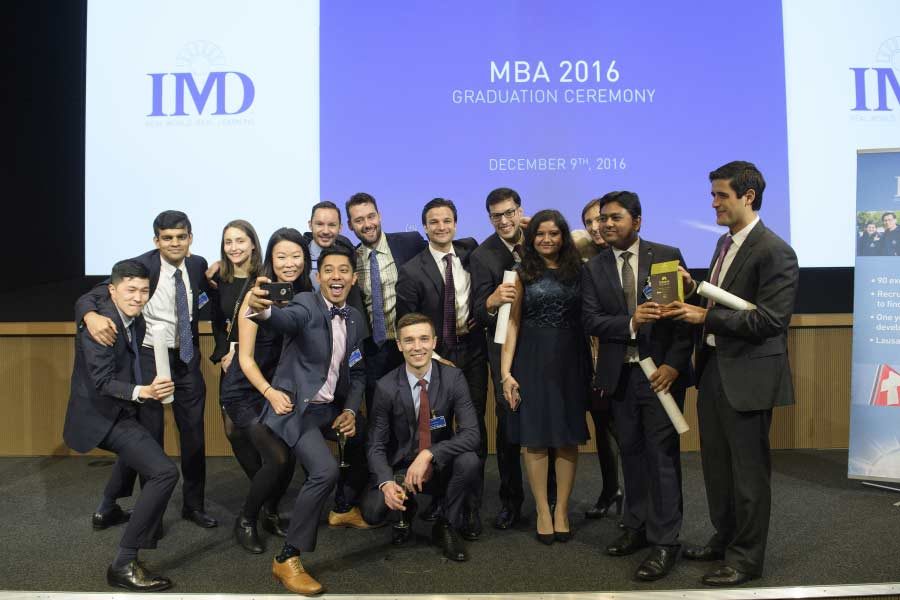
The IMD assessment day is where IMD decides who joins its one-year MBA in Lausanne. If you are on the shortlist, or hope to be, this guide shows what happens and how to prepare.
Last updated: 31 October 2026
The short answer: instead of a standard interview, IMD runs a day of individual and group tasks plus an interview. You can attend online or on campus. Your performance also counts towards IMD’s main scholarships.
IMD assessment day: what you need to know in 60 seconds
- IMD in Lausanne runs a one-year, full-time MBA from January to December for a class of about 90 students. Instead of a standard interview, shortlisted applicants attend an assessment day.
- The day mixes individual and group tasks with your interview. IMD offers it online or on campus, and it is also where IMD checks your English.
- The Class of 2028 (starting January 2028) has six deadlines, from 26 January 2027 to 12 October 2027. Each leads to an assessment day ten days to four weeks later.
- Fees are CHF 97,500: tuition of CHF 80,000 plus mandatory fees of CHF 17,500. IMD says 48% of students receive a scholarship, and your performance on the day counts towards its main awards.
- The regional “assessment challenges” described in older versions of this article no longer appear on IMD’s MBA pages.
What is the IMD MBA? The programme at a glance
| Format | Full-time, one year (January to December), Lausanne, Switzerland |
| Class of 2026 profile | 90 students, 34 nationalities, average age 30, average six years of work experience, average GMAT 615 |
| Work experience | At least two years full-time after graduation; the typical range is three to eight |
| Tests | GMAT, GRE or Executive Assessment; IMD recommends 555 or above on the GMAT, or an equivalent score |
| Application fee | CHF 150 (non-refundable) |
| Fees | CHF 97,500, plus living costs of about CHF 36,000 for a single person |
| Degree | A Master of Advanced Studies (MAS) worth 90 ECTS credits, from a Swiss-accredited university institute with AACSB, EQUIS and AMBA accreditation |
| Careers (Class of 2025) | 78% had a job offer within three months of graduating; median salary US$176,000, adjusted for purchasing power |
| FT Global MBA Ranking 2026 | 30th |
Sources: IMD’s MBA overview, admission process, fees, careers and class profile, programme and scholarships pages; the FT Global MBA Ranking 2026.
Best for: professionals with three to eight years’ experience who want a small, intense class and a quick return to work.
Why is there an IMD assessment day at all?
IMD’s class is small and the year is intense. Much of the work happens in teams, including consulting projects for companies. In fact, IMD says 40% of the MBA happens outside the classroom.
For example, its International Consulting Projects put you in a team for seven weeks, working for a multinational or nonprofit client. IMD says it has run over 750 such projects for 400 companies since 1980.
An interview alone shows how well you have prepared your answers. By contrast, a day of group work shows how you behave when you haven’t. It reveals whether you listen, how you handle pressure and disagreement, and how you take feedback on the spot.
IMD says it looks at academic ability, career progression, achievements, leadership, international outlook, integrity, drive, initiative and interpersonal skills. The assessment day tests several of these together. IMD also uses it to judge your English, so there is no separate English test.

When is your IMD assessment day? Class of 2028 dates
IMD’s admissions page lists six deadlines for the class starting in January 2028. Your assessment day depends on the deadline you apply in. When we checked on 28 and 31 October 2026, IMD also said applications for the Class of 2027 were still open.
| Application deadline | Online assessment day | On-campus assessment day |
| 26 January 2027 | 5 February 2027 | 12–13 February 2027 |
| 16 March 2027 | 2 April 2027 | 9–10 April 2027 |
| 4 May 2027 | 14 May 2027 | 21–22 May 2027 |
| 13 July 2027 | 23 July 2027 | 6–7 August 2027 |
| 7 September 2027 | 17 September 2027 | 24–25 September 2027 |
| 12 October 2027 | 22 October 2027 | No on-campus date listed |
The gap between deadline and assessment day can be as short as ten days. So if you are applying from India and want the on-campus option, sort out your travel and visa for Switzerland before you submit.
Example: apply by 16 March 2027, and your online day falls on 2 April. The campus option is 9–10 April, about three weeks after the deadline.
What do you submit before the day?
- Transcripts for all degrees, with official English or French translations.
- A GMAT, GRE or Executive Assessment score less than five years old.
- One business reference, from a professional email address, not Gmail or Hotmail.
- A one-page CV on IMD’s own template; IMD does not accept other formats.
What happens on the IMD assessment day?
IMD’s own description is brief: a mix of individual and group tasks in addition to your interview. The exact exercises change from year to year. Past formats have included:
- a personal interview, usually with a member of the admissions team who has read your file closely;
- a case study analysed and presented in small teams, followed by a debate with another team;
- a short individual task with preparation time and a presentation;
- a group exercise, followed by a debrief in which participants assess each other’s contributions;
- on campus, informal time with students, staff and other candidates.
Assume someone is observing you throughout, even during the informal parts.
Inside one GyanOne client’s IMD assessment day
This account comes from a GyanOne client, a former armed forces officer, who attended an on-campus assessment day in an earlier admissions cycle. The format has changed since, because online days now run alongside on-campus ones. Still, the types of exercise are a good guide to what IMD values.
Introductions, the interview and the case
Introductions. Seven candidates were in the group. Before the interviews began, each introduced themselves. Our client mentioned an interest in windsurfing alongside their work background.
The interview. The interviewer, then the head of MBA recruitment, had clearly studied the file. The questions started with our client’s experience in the forces: critical situations they had faced, how they analysed them, and what leadership meant to them.
Then came the MBA questions: why an MBA now, short- and long-term goals, and why IMD.
The case. Candidates received a case and worked in two teams, of three and four. After the analysis, one member of each team presented its strategy. Then the floor opened, and each team had to challenge the other’s plan.
The other team argued that our client’s team had not chosen a specific target market. In reply, the team defended its view that all its markets mattered equally. It also pointed out weaknesses in the other team’s strategy.
The individual task, the group activity and dinner
The individual task. Each candidate drew a card with a question and had about 30 minutes to prepare a short answer. Our client’s question was: “If you could live forever, would you want to, and why?”
They said no, because they did not want to age in poor health. Instead, they drew on the idea of reincarnation in Hindu philosophy to explain why they would rather experience different lives. A group discussion of everyone’s answers followed.
The group activity. Wearing blindfolds, candidates had to identify shapes and their colours from a moderator’s clues, asking only certain kinds of questions. Together they identified three of the four characteristics.
However, the debrief mattered more than the result.
Asked how it felt to wear a blindfold, our client said they expected the task to rely on touch and hearing. It also reminded them of training to handle a rifle blindfolded.
Next, the candidates rated the team on process and result.
One candidate rated the team highly for listening. The moderators pointed out that the same person had ignored a valid point our client had raised. That candidate replied that our client needed to communicate better, so the moderators asked our client to respond.
Their answer: the exercise had a time limit, and they chose not to stop the team’s progress to argue the point.
Dinner. The day ended with a networking dinner with students and others from IMD. It felt relaxed, but it was still part of the experience.
What you can learn from this IMD assessment day
- Hold a position calmly. When challenged, the team explained its view, then examined the other plan.
- Answer abstract questions with your values. Our client gave a clear “no” and explained it through their own beliefs.
- Reflect out loud. In the debrief, our client linked the task to their own training.
- Explain, don’t defend. Faced with criticism, our client gave a reason: the time limit.
How to prepare for the IMD assessment day
- Know your file. The interviewer will use your CV, essays and recommendation. Prepare specific stories about leadership, a difficult decision, a failure and a conflict. Also prepare a clear answer to “why IMD, why now”.
- Practise thinking aloud on a case. You don’t need consulting experience. But you should be able to structure a business problem, choose a position and defend it calmly.
- Contribute, but let others in. In group tasks, IMD is watching how you work with people as much as whether the group succeeds. Building on someone else’s idea counts for as much as having your own.
- Take feedback well. Expect peers or moderators to comment on your behaviour. Listen, acknowledge what is fair and explain your reasoning without getting defensive.
- Practise short, unprepared answers. Abstract questions (“would you live forever?”) test how you structure your thinking and what you value. They don’t test whether you find the “right” answer.
- For an online day, test your connection, camera and space in advance. Also practise speaking up in video group discussions, where it is easy to get talked over.
Our MBA interview preparation uses mock interviews and group exercises built around each school’s format. For a broader view of IMD’s interview, see our article on the IMD admissions interview process.
Online or on campus: which IMD assessment day should you pick?
- Online: one day, for all six deadlines, 10 to 17 days after each. You avoid travel.
- On campus: two days in Lausanne, for the first five deadlines, 17 to 24 days after each. You also meet students.
What this means for you: IMD’s pages show no preference. So if your visa timing is tight, choose online.
How does the IMD assessment day affect scholarships?
IMD says 48% of its MBA students receive a scholarship or bursary, and that more than half of its scholarships go to women. “Performance during the Assessment Day” is a listed criterion for its main awards:
- the MBA5 Scholarship (CHF 50,000), which also asks for a 750-word essay;
- the Hilti STEM Scholars Program (CHF 50,000);
- the Nestlé Scholarship for Women (CHF 40,000);
- the Forté Scholarship for Women (CHF 30,000);
- merit scholarships of up to CHF 40,000.
You apply for these in the programme section of your MBA application form. If you need a need-based bursary, request it at the same time as your application.
What this means for you: a strong day can be worth tens of thousands of francs.
What does the IMD MBA cost?
The CHF 97,500 total covers tuition plus a pre-programme course, travel for IMD-organised projects, coaching and books. You pay it in four instalments, starting with a non-refundable CHF 10,000 deposit two to four weeks after your offer. Any scholarship comes off the last instalments.

What happened to the assessment challenges?
In earlier years, IMD ran one-day “assessment challenges”, some for particular regions or for women. In them, shortlisted participants competed for a place in the class and a scholarship.
IMD’s current MBA pages, including its events calendar for late 2026, list information sessions, panels, coffee chats and fairs, but no challenges. Check IMD’s events page before you plan around one.
Who does the IMD MBA suit?
It suits you if you have three to eight years of experience, want a small class, and enjoy teamwork and direct feedback. It also suits career changers: IMD says 92% of graduates switch role, industry or country.
Look elsewhere if you have under two years of full-time work. Still deciding on format? Our guide to one-year vs two-year MBAs can help.
IMD assessment day FAQs
Is the IMD assessment day online or on campus?
Both. Every Class of 2028 deadline has an online date, and the first five also have a campus option.
Can a weak IMD assessment day cost me a scholarship?
It can, because performance on the day is a criterion for IMD’s main merit awards.
For costs and GyanOne client stories, see our IMD MBA fees and class profile page and Ishan Singla’s IMD admit story.
GyanOne has helped 5,000+ applicants over 18+ years. Getting ready for your IMD assessment day? See our MBA interview preparation, or book a free 30-minute profile evaluation call with a GyanOne consultant.
Preparing for an admissions interview?
Tell us which schools have invited you. We'll tell you what their interviewers look for and how to prepare.
Get a free profile evaluationWhatsApp us
A free 30-minute one-on-one call with a GyanOne consultant. No obligation.


MBA admissions consultants since 2008, led by Founder Rishabh Gupta, a Poets&Quants top-10 MBA admissions consultant in 2023, 2024 and 2025 (No. 12 in 2026), and Co-Founder and Managing Partner Swati Gupta: a top MBA with 18+ years of industry experience who designed every GyanOne consulting programme and built our interview coaching to be the best in the world. 5,000+ applicants helped, and 500+ admits to M7 schools for our clients. Meet the team


