

He Was Rejected. He Came Back. Oxford Said Yes.
When Arshul Sharma received his LBS rejection, he did what most people in that situation do not. He did not blame the school, or the process, or the competition. He looked at the application and asked a harder question: what had it failed to say?
The answer, when it came, was uncomfortable. The application had been technically competent. It had listed the right things — Bain, the awards, the promotions. What it had not done was tell the truth about where his conviction actually came from. Not from a Bain boardroom. Not from a global hackathon. From a few streets near his home in Delhi, where shop owners during a vaccination drive had told him the same story over and over: missing one day of revenue meant a supplier went unpaid.
He came to GyanOne as a re-applicant. Oxford Saïd said yes.
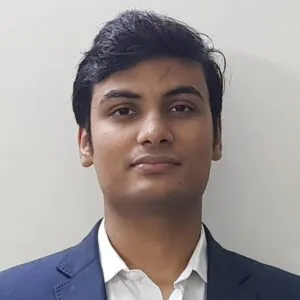
THE FAMILY THAT KNEW BOTH FAILURE AND REINVENTION
Arshul grew up in Pitampura, Delhi, in a family that had lived both sides of the business story.
His grandfather was a retired army Major who, after service, started a venture that his sons eventually managed. It had its years. Then it didn’t. The business shut down. His father, an engineer by training, joined an MNC as a manager and made a decision that Arshul watched closely from childhood: he pursued his MBA while working, climbed from manager to CEO of an automobile firm over 25 years, and then left to build his own motorcycle dealership business across Delhi.
“My father’s arc is the one I grew up inside,” Arshul says. “A failed family business. Corporate service. His own MBA while working. And then, eventually, something of his own. I understood from very early on that these things are not linear. That failure is not the end of a story. That education can change the trajectory of a family.”
His mother taught mathematics and economics at a government school. His grandfather taught him English during summer holidays, finishing entire textbooks together. These are not small details. They are the infrastructure of a person — the people who shaped how he learned, what he valued, and why he believed that help is only real if it outlasts the person giving it.
NSIT, A PANDEMIC, AND A PLACEMENT RECORD THAT STILL STANDS
At NSIT — now NSUT, part of Delhi University — Arshul studied Electronics and Communication Engineering and finished with a 7.38 CGPA. He was worried about the number. What he did around it was harder to dismiss.
As Head of Training and Placement, he brought more than 2,000 companies to campus for the recruitment drive — a college record that still stands — and delivered a 100% placement record despite COVID. He co-founded the All India AI/ML Master’s Community NSIT chapter, which grew to 200 members in its first year and remains active. He won the NASA CanSat Competition, placing first in India and twelfth worldwide. He organised mammography camps across Delhi through Rotaract, identifying 30 missed cases in women who had not been screened. He raised sponsorships worth ten lakhs for the cultural fest in the middle of a pandemic.
“I was not trying to build a resume,” he says. “I was just trying to make things work in an environment where nothing was guaranteed. That’s what COVID taught all of us. You either find a way or nothing happens.”
BAIN, AND THE PATTERN OF OPERATING ABOVE YOUR LEVEL
Arshul joined The Smart Cube straight out of college and moved to Bain’s Capability Network within six months. What followed was a pattern that showed up consistently across his Bain years: he kept operating above the level he was supposed to be at, and Bain kept noticing.
Accelerated promotion, skipping the Senior Analyst level entirely to become Associate. Currently operating as Emerging Project Leader, again one year ahead of schedule, leading a team of four. Bain Star Analyst Award in 2023. Bain Star Team Award in 2024. Winner of Bain’s annual global Hackathon — an idea currently being incubated by Bain’s startup arm. The only analyst selected to go to Poland to set up a BCN office for handling Europe’s workload. Then selected as front-runner to establish an on-ground team in Manila for APAC.
He delivered expert Tableau seminars to approximately 1,500 Bain employees. He leads rapid diagnostics for Bain’s Value Calculator product, working through chaotic ERP systems and contradictory bank records. His personal standard, the one he articulates with unusual clarity, is this: success is whether performance keeps improving after he has left.
“The PE portfolio programme I led is now operated independently by the client,” he says. “No ongoing Bain support. Performance continued improving after my departure. That is what I was trying to build. Not something that needed me. Something that didn’t.”
It is, in retrospect, the most important sentence in his application. And it came not from a business school framework but from a conviction formed much closer to home.
NIGERIA, AND WHERE THE CONVICTION CAME FROM
Through Bain, Arshul took a four-month pro-bono externship with TechnoServe, living and working in Abuja and Lagos. He designed a ten-million-dollar investment fund and the strategy for a two-hundred-million-dollar investment to be injected into Nigeria’s agro-economy over five years — touching a million lives, targeting youth employment, and reinforcing the agro-MSE sector during a period of stagflation.
“Nothing in my career had prepared me for it and everything in my career had prepared me for it,” he says. “The analytical toolkit was useful. But what I needed in Nigeria was something else entirely. The ability to understand a context that was completely different from anything I had worked in before, and to build something that would keep working after I left.”
He watched the same thing happen that had happened on the Delhi vaccination drives: the people he was working with were not waiting for someone to solve their problems. They were waiting for someone to help them solve their own problems, and then get out of the way. The conviction that had been forming slowly — if the help leaves with the consultant, it was never really help — crystallised in Lagos in a way that no boardroom had ever managed to produce.
THE GMAT THAT DIDN’T DEFINE HIM
Arshul’s GMAT journey tells its own story. 675 on the first attempt. 645 on the second — a score he rejected before it could be sent. 695 on the third. Three attempts. Not a 750. Not even a 700.
“I was not going to let it stop me,” he says simply. “I knew what the number was. I also knew what the work was. And I believed that if I could find the right way to tell the story of the work, the number would not be the loudest thing in the file.”
He was right. But the first application had not told the story of the work correctly. Which is why the rejection happened, and why it mattered.
THE RE-APPLICATION THAT CHANGED EVERYTHING
When Arshul came to GyanOne, the first task was diagnosis. What had the LBS application said, and what had it failed to say?
The answer was clear. It had positioned him as a high-performing Bain analyst with impressive metrics. Which he was. What it had not done was explain where his consulting mission came from — not from Bain’s methodology or his accelerated promotions, but from watching shop owners near his home in Delhi describe the economics of missing one day of wages. He had redesigned vaccination drive schedules so that people did not have to sacrifice income to participate. Participation immediately increased. That instinct — understanding that a solution only works if it fits the actual life of the person using it — was the thread connecting everything. The Lagos work. The Delhi drives. The PE portfolio that kept improving after he left.
GyanOne rebuilt the Oxford application around that thread. The personal statement opened a few streets from his home in Pitampura — not in a Bain office, not at a global hackathon, but at a vaccination camp where the gap between good intentions and real impact was visible and specific and fixable.
His Bain Capability Network role, often perceived as a back-end support function, was reframed as exactly what it had been: a series of deployments to Poland, Manila, and Nigeria, operating consistently above his level, by a person whose standard for success was whether things kept working after he walked away.
The acknowledged communication weakness — his recommenders had noted a tendency toward over-detail, difficulty pushing back on client requests, and inconsistent stakeholder communication — was handled directly and honestly. Not minimised. Examined, with specific evidence of what he had done to address it.
Oxford Saïd said yes.
FOR THE RE-APPLICANT WHO WONDERS IF IT IS WORTH IT
“The rejection was useful,” Arshul says. “I didn’t feel that way at the time. But it forced me to look at the application and ask what it was actually saying. And the answer was that it was saying the right things in the wrong order, from the wrong place.”
For applicants who have been rejected and are considering whether to try again — whether the effort is worth it, whether a different approach will actually make a difference — his journey holds a direct and honest answer. The profile did not change between the LBS rejection and the Oxford admit. The 695 GMAT was the same. The 7.38 undergraduate CGPA was the same. The Bain role was the same. What changed was the story, and where it started, and what it was actually trying to say.
“My grandfather taught me English during the summer holidays,” Arshul says. “My father built something of his own after years of working for someone else. My mother taught maths in a government school. These people shaped how I think about what help actually means. That is the application Oxford said yes to. Not the metrics. The meaning behind them.”
Arshul Sharma is a GyanOne client who was admitted to Oxford Saïd Business School. GyanOne has helped re-applicants, below-target scorers, and candidates with non-linear profiles earn admission to the world’s top MBA programmes. If you are applying in 2026, start the conversation.


 info@gyanone.com
Leave a Reply