
Oxford MBA Admits: GyanOne Client Stories From Saïd Business School

Can someone with your background get into the Oxford MBA? These GyanOne clients came from the Indian Army, medicine, the social sector, space research, consulting, finance and analytics. Their stories show what Oxford Saïd actually rewards.
Last updated: 31 October 2026
The short answer: there is no single Oxford profile. Our clients had between three and 11 years of experience. Each application told one specific story, backed by evidence.
Oxford MBA: what you need to know in 60 seconds
- The programme: the Oxford MBA is a one-year, full-time MBA at Saïd Business School. The course fee for 2027–28 is £94,120.
- The class: the Class of 2025–26 has 332 students from 63 nationalities. 96% are international, and they have five years’ work experience on average.
- Scores: the median GMAT Focus score is 635, which equals 690 on the previous edition.
- Still open for September 2027: Stage 3 (4 November 2026), Stage 4 (6 January 2027) and Stage 5 (15 March 2027). Stage 4 is the last stage for University of Oxford scholarships.
- On this page: some of the GyanOne clients admitted to Oxford Saïd. We profile a few below with links to their full stories, and more have their own story pages.
Who are GyanOne’s Oxford MBA admits?
Here is the group at a glance. Note that the GMAT column shows each score as the client’s story published it, so most are on the old exam.
| Client | Background | GMAT, as published | Admits |
| Prasham Vir Sarmah | McKinsey, Deloitte, Indian Oil, Sharekhan; four years | 700 (old exam) | Oxford, Cambridge Judge, LBS |
| Dr Prashanth Rajagopalan | Doctor; founder of a 600-bed hospital chain; 11 years | Not published | Oxford Saïd, Kellogg Executive MBA, LBS Executive MBA |
| Anjali Kharbanda | TresVista, IIFL Asset Management; three years | 700 (old exam) | Oxford |
| Kshitij Verma | Indian Army officer, Lieutenant to Major; seven-plus years | Not published | Oxford |
| Rhea Handa | Education and development: Central Square Foundation, J-PAL South Asia, The Antara Foundation; six-plus years | Not published | Oxford |
| Harsha Sanyukta | Sattva Consulting, PwC India, Unacademy; six years | 680 (old exam) | Oxford, with a full scholarship |
| Abhinav | ISRO flight-software engineer; six UPSC attempts | 640 twice, then higher (final score not published) | Oxford, HEC Paris; chose Oxford |
| Vikas Choudhary | IIT Kharagpur; EXL, Gartner, Eightfold.ai; about ten years | 720 (old exam) | Oxford, Ivey; scholarship offers from both |
| Shubham Sharma | IIT Kharagpur; seven-plus years at EXL Analytics | 710 (old exam) | Oxford |
| Arshul Sharma | The Smart Cube, Bain Capability Network; re-applicant | 695 (third attempt) | Oxford, after an LBS rejection |
| Vineet Pavate | Engineer; VR start-up co-founder; Greentern Consulting | 675 (Focus Edition) | Oxford, ESADE |
| Gaurav Goyal | Family steel business; Mosaic Wellness; two start-ups | 740 (old exam) | Oxford, Kellogg One-Year MBA |
| Divya Sriram | Deloitte, then Google; about four years | 700 (old exam) | Oxford, Cambridge Judge, LBS; chose LBS |
| Revati Asthana | KPMG consultant | Not published in the story | Oxford, INSEAD; chose INSEAD |
How do their old GMAT scores compare with the Focus Edition?
Most of these clients took the old GMAT. So we converted their scores with GMAC’s concordance table, which links the two exams.
| Old-exam score | GMAT Focus Edition equivalent |
|---|---|
| 680 | 615–635 |
| 700 | 645–655 |
| 710 | 655–665 |
| 720 | 665–675 |
| 740 | 685–695 |
What this means for you: several of these clients won places with scores close to Oxford’s current median of 635. So a strong story mattered more than a top-percentile score.

Six Oxford MBA stories in more detail
Prasham Vir Sarmah: Oxford, Cambridge and LBS with a 700
 Profile: B.Com (Hons) from Shaheed Bhagat Singh College, University of Delhi. Prasham spent four years across McKinsey & Company, Deloitte, Indian Oil Corporation and Sharekhan, and scored 700 on the old GMAT.
Outcome: admits from Oxford Saïd, Cambridge Judge and London Business School. Before that, Prasham interviewed at those three schools and at INSEAD.
What made the difference:
- A varied career, presented as a deliberate range rather than a scatter.
- Adaptability, shown through moves between cities, schools and countries.
- Applications written separately for each school.
In Prasham’s words, from a verified review on Poets&Quants: “I was a bit late starting the process, and had limited time, but all my apps got done well ahead of deadlines with no stress.” Read Prasham’s story.
Dr Prashanth Rajagopalan: a doctor who built a hospital chain
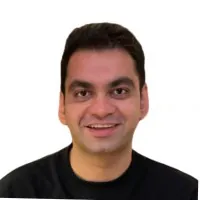 Profile: MBBS from Sri Ramachandra University. After that, Prashanth spent 11 years in healthcare and medical education. That included Sri Balaji Educational & Charitable Public Trust, Mahatma Gandhi Medical College & Research Institute and MGM Healthcare. At MGM Healthcare, Prashanth was Founder and Managing Director of a 600-bed hospital chain in Chennai.
Outcome: admitted to Oxford Saïd, the Kellogg Executive MBA and London Business School’s Executive MBA.
What made the difference: business results came first. Then came a clear view of healthcare’s future, and an honest, brief account of a past decision.
- More than 200 specialist doctors and 1,500 healthcare professionals brought in over five years.
- An annual turnover of US$50 million, with patients from more than 40 countries.
- A clear belief that healthcare will be India’s next big contribution to the world after technology.
- An honest, brief account of leaving a Johns Hopkins MPH/MBA programme.
Anjali Kharbanda: the Oxford MBA with three years’ experience
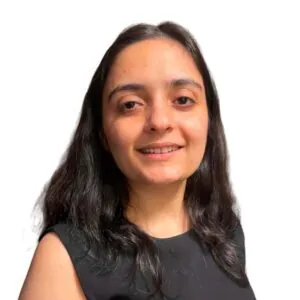 Profile: B.Com (Hons) from the University of Delhi, then three years at TresVista and IIFL Asset Management. On the old GMAT, Anjali scored 700.
Outcome: admitted to the Oxford MBA.
What made the difference:
- Fast progression to an associate role supervising three analysts.
- Responsibility for the Global Impact and Capital Markets accounts.
- A client digital project that Anjali led.
- A clear answer to why the MBA made sense early.
Kshitij Verma: from Indian Army Major to the Oxford MBA
 Profile: B.Tech, First Class with Distinction, then more than seven years as an Indian Army officer. Kshitij rose through three postings:
- Lieutenant and Platoon Commander in Kashmir.
- Captain and Mortar Platoon Commander in Rajasthan.
- Major, Battalion Quartermaster and Company Commander in Meghalaya.
Outcome: admitted to the Oxford MBA.
What made the difference: military work translated into business terms.
- Logistics for an 800-person combat unit, including high-altitude deployments, presented as operations management.
- International training exercises, used as evidence of cross-cultural work.
- Commendations for strategic vision, disaster management and inter-agency coordination.
In Kshitij’s Google review of GyanOne: “My leadership experience in the military was strong, but my business exposure was limited.” Read Kshitij’s story.
Rhea Handa: from education research to the Oxford MBA
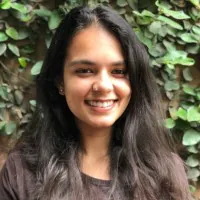 Profile: a dual major in Economics and Politics at Scripps College, focused on economic development and political economy. Rhea also took the Washington Program at Claremont McKenna College.
After college, Rhea spent more than six years with Central Square Foundation, J-PAL South Asia and The Antara Foundation, and also worked as a consultant to the Center for Universal Education.
At college:
- Dean’s List.
- Co-President of the Scripps International Community.
- Student Representative on the Scripps College Board of Trustees.
- A senior thesis titled “A Lesson in Learning: Improving Learning Outcomes in India via Pedagogical Innovation”.
Outcome: admitted to the Oxford MBA.
What made the difference: academic strength and leadership roles from college onwards. Above all, a commitment to social impact ran in a straight line. It went from a senior thesis on learning outcomes in India to six years of work in education and development.
Harsha Sanyukta: a 680 GMAT and a full scholarship
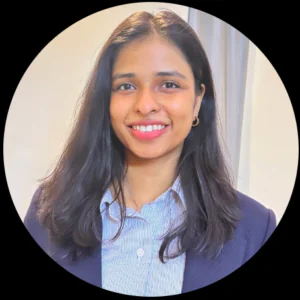 Profile: BA in History from St Stephen’s College, Delhi. Harsha did early research for the National Commission for Scheduled Castes, then spent six years across Sattva Consulting, PwC India and Unacademy. On the old GMAT, Harsha scored 680.
Outcome: admitted to the Oxford MBA, plus a full scholarship.
What made the difference: social-sector work, told with numbers.
- A 10-year roadmap for an education project aimed at 10 million rural school dropouts.
- An open schooling programme that reached 10,000 out-of-school girls.
- An India market-entry strategy for a US-based healthcare NGO.
Where can you read more Oxford MBA stories?
- Abhinav: an ISRO flight-software engineer who made six UPSC attempts. Abhinav then won admits from Oxford and HEC Paris, and chose Oxford.
- Vikas Choudhary: an IIT Kharagpur engineer in analytics at EXL, Gartner and Eightfold.ai. Vikas applied late in the cycle and won offers from Oxford and Ivey, with scholarships from both.
- Shubham Sharma: from Moradabad and IIT Kharagpur to seven years at EXL Analytics, with clients across Africa.
- Arshul Sharma: rejected by LBS, then admitted to Oxford as a re-applicant with a rebuilt story.
- Vineet Pavate: shut down a VR start-up, then won admits from Oxford and ESADE.
- Gaurav Goyal: from the family steel business, with a green steel thesis, to Kellogg’s One-Year MBA and Oxford.
- Divya Sriram: from Deloitte and Google to admits at Oxford, Cambridge and LBS.
- Revati Asthana: a KPMG consultant admitted to INSEAD and Oxford.
Other GyanOne clients admitted to Oxford include Aravind Garipally, Kartik Garg, Divya Chaurasia, Anshul Vohra and Arjun Arun. You will find them on our reviews and achievements page.
What is the Oxford MBA like today?
These are Oxford Saïd’s published figures for the 2027–28 cohort. They come from its Oxford MBA and application requirements pages, as verified for our Oxford MBA essays guide.
| Programme | One-year, full-time MBA at Saïd Business School; every student also joins an Oxford college |
| Class of 2025–26 | 332 students, 63 nationalities, 96% international, 48% women, five years’ average work experience |
| Experience | At least two years’ full-time work experience |
| Tests | GMAT or GRE required, with no waivers. Oxford calls 595 or more on the GMAT Focus Edition (650 on the previous edition) competitive; the current class median is 635 (690 on the previous edition) |
| English | IELTS Academic (7.5 overall, at least 7.0 in each part) or an approved waiver; Oxford is not accepting TOEFL tests taken from 21 January 2026 |
| Written work and video | A 500-word supporting statement, career-plan questions in the application form, and a Kira video assessment with three questions |
| Course fee | £94,120 for 2027–28; application fee £75 |
| Deadlines still open | Stage 3: 4 November 2026; Stage 4: 6 January 2027 (the last stage for University of Oxford scholarships); Stage 5: 15 March 2027. Each closes at 23:59 UK time, 5:29 am IST the next day |
Best for: professionals with a few years’ experience who want one intense year. It also suits those who want a very international class and life in an Oxford college.
What this means for you: the class is global and experienced. So your application must show what you, specifically, will add to it.

What do these Oxford MBA admits teach you?
There is no single Oxford profile
An Army Major, a hospital founder, a social-sector strategist, a space engineer and a finance associate with three years’ experience all got in. Yet what they shared was a story the committee could believe.
Is a score near the median enough?
Yes, when the rest of the application is specific. Harsha’s 680 and Prasham’s and Anjali’s 700s sit around Oxford’s current median.
By contrast, Abhinav’s earlier 640 fell just below Oxford’s competitive line. A retake fixed that before applying.
Translate an unusual career into management terms
Think of hospital beds and hires, supply chains at altitude, or girls reached by a schooling programme. When you give numbers and decisions, even unfamiliar work becomes easy to judge.
Turn a setback into part of the story
Arshul came back from an LBS rejection with a rebuilt story. Vineet shut down a start-up, then won two admits. Prashanth gave an honest, brief account of leaving a programme. Handled this way, a setback can show judgement rather than leave a gap.
Write for each school
Prasham wrote applications separately for each school, and won three admits. After all, a copied essay rarely survives a careful reader.
When should you apply to the Oxford MBA?
If you need funding, apply by Stage 4. If you are late, as Vikas was, a focused application can still work. Even then, leave time for the Kira assessment and your referees.
Who does the Oxford MBA suit?
It suits you if:
- You have at least two years of full-time work, and ideally a record of growing responsibility.
- You want a one-year MBA rather than two years away from work.
- A class that is 96% international excites you rather than worries you.
- You are ready to take the GMAT or GRE, since Oxford gives no waivers.
Look elsewhere if: you cannot take a GMAT or GRE before your chosen stage, or you would prefer a two-year programme. Compare options in our guide to top MBA programmes in the UK.
Oxford MBA: frequently asked questions
What GMAT score do I need for the Oxford MBA?
Oxford calls 595 or more on the GMAT Focus Edition competitive, and its current median is 635. Even so, several clients on this page got in with scores near that median.
Can I get in with three years’ experience?
Yes, if your progression is strong. Oxford asks for at least two years, while the class average is five. Anjali, for example, got in with three years.
Does Oxford accept TOEFL?
Not for tests taken from 21 January 2026. Instead, Oxford asks for IELTS Academic, with 7.5 overall and at least 7.0 in each part, or an approved waiver.
When should I apply if I need a scholarship?
Apply by Stage 4, on 6 January 2027. That is the last stage for University of Oxford scholarships. Harsha won a full scholarship, and Vikas received scholarship offers from Oxford and Ivey.
What does the Oxford application include?
First, you write a 500-word supporting statement and answer career-plan questions in the form. Then you complete a Kira video assessment with three questions, and pay a £75 fee.
Guides for your Oxford MBA application
- Oxford MBA essays: supporting statement, Kira assessment and deadlines
- Video essay and Kira practice and MBA interview preparation
- MBA scholarships for Indian students
- Top MBA programmes in the UK and Cambridge Judge MBA essays
Sources: Oxford facts are Oxford Saïd Business School’s published figures for the 2027–28 cohort, as verified for our Oxford MBA essays guide on 29 October 2026. Client details come from GyanOne’s published client stories and clients’ own reviews. Score equivalents come from GMAC’s GMAT score concordance table (August 2026).
If the Oxford MBA is on your list for September 2027, book a free 30-minute profile evaluation call with a GyanOne consultant. Or see how our MBA essay editing team works on the supporting statement, career plan and Kira practice.
Applying to Oxford?
Tell us about your profile. We'll tell you where you stand at Oxford and how to make your strongest case.
Get a free profile evaluationWhatsApp us
A free 30-minute one-on-one call with a GyanOne consultant. No obligation.


MBA admissions consultants since 2008, led by Founder Rishabh Gupta, a Poets&Quants top-10 MBA admissions consultant in 2023, 2024 and 2025 (No. 12 in 2026), and Co-Founder and Managing Partner Swati Gupta: a top MBA with 18+ years of industry experience who designed every GyanOne consulting programme and built our interview coaching to be the best in the world. 5,000+ applicants helped, and 500+ admits to M7 schools for our clients. Meet the team


